
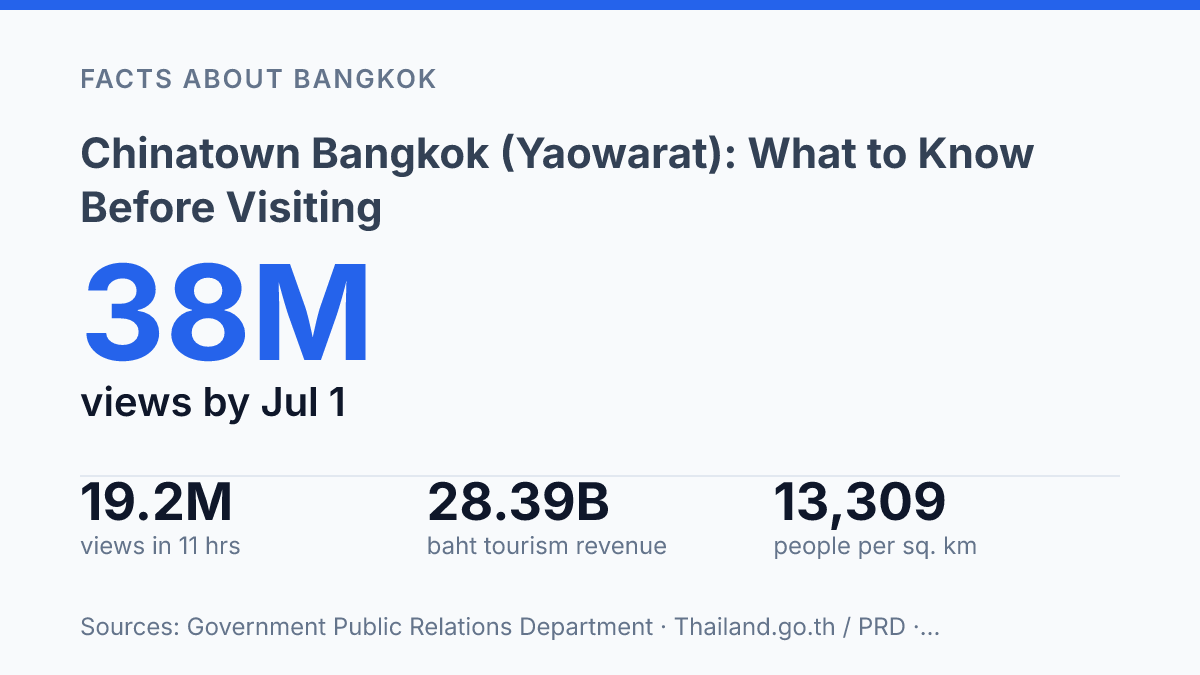
Chinatown Bangkok (Yaowarat) is anchored by a main road of about 1.4 km, yet it sits inside one of the city’s densest districts: Samphanthawong recorded 13,309 residents per sq. km in 2024, nearly four times Bangkok’s overall density. That contrast explains why Yaowarat is more than a night market or a food street. It is a compact historic quarter where commerce, housing, temples, clan associations, transit, and festival tourism overlap within a small urban area.
The district is also unusually easy to locate: MRT Wat Mangkon Exit 1 serves Yaowarat Road, Plaeng Nam Road, Phadung Dao Road, and nearby Chinatown landmarks. Understanding the area means looking at how Bangkok’s Chinese community took root there, how the street works as a navigable corridor, why it changes after dark, and why recent events, from Chinese New Year tourism to Lisa’s 2024 “Rockstar” video, have pushed it further into public view.
Why Yaowarat became Bangkok’s Chinese quarter
Yaowarat’s Chinese quarter was shaped first by concentration: immigrant merchants, laborers, clan networks, shrines, shops, and homes clustered tightly enough for the area to become Bangkok’s main Chinese commercial community within the early Rattanakosin period. When Bangkok was founded as the capital of the Rattanakosin Kingdom in 1782, Chinese settlers were already central to regional trade, and the new capital’s river-based economy gave them a practical base for commerce, warehousing, food supply, and small-scale manufacturing.
The dominant early community in the district was Teochew, a Chinese-speaking group from eastern Guangdong with strong maritime trading links across Southeast Asia. Their settlement pattern was not only residential; it was organized around kinship associations, temples, market lanes, credit relationships, and family businesses. That structure helped newcomers find work and housing, while also allowing Chinese-owned enterprises to serve both their own community and the wider city.
Over time, the district’s identity expanded beyond a migrant enclave into a dense commercial quarter associated with gold shops, herbal medicine, food trading, religious institutions, and street-level retail. This growth explains why Yaowarat is now widely described as one of the largest Chinatowns in the world: its scale is not simply a matter of one road, but of a wider urban fabric built through generations of settlement, trade, and community institutions.
The area is often presented as a single heritage district, but its role has never been fixed. Early migration gave it an ethnic and linguistic foundation; commerce made it economically central; later urban development turned Yaowarat Road into the symbolic spine of the neighborhood. The result is a district where Chinese heritage remains visible, but not frozen, because its streets have repeatedly adapted to new patterns of business, mobility, and public attention.
Where Yaowarat Road sits and how to find it
The road most closely identified with Bangkok’s Chinatown is only about 1.4 km long, which is why the name “Yaowarat” can refer to both a precise street and a broader urban district. In its narrowest sense, Yaowarat Rd is the main street associated with the area, running through the commercial core of Bangkok’s Chinatown and anchoring the lanes, shopfronts, markets, and side streets around it.
The formal address for the road is Yaowarat Rd, Khwaeng Chakkrawat, Khet Samphanthawong, Bangkok 10100, Thailand. This places it in Samphanthawong, a central Bangkok district on the historic inner-city side of the Chao Phraya River, close to other long-established commercial streets rather than in a suburban enclave. A 2024 study defines Bangkok’s Chinatown study area as lying between Charoen Krung Road to the north and Song Wat Road to the south, with Yaowarat Road serving as the main tourism spine, according to Pan, Cogent Arts & Humanities.
In practical terms, “Yaowarat” is often used as shorthand for the wider Chinatown area, but the most accurate geographic reference is the road and its immediate surroundings. That distinction matters because maps, taxis, district references, and tourism descriptions may not all use the term at the same scale. The road is the clearest fixed point: find Yaowarat Road within Samphanthawong, then the surrounding Chinatown streets form the larger neighborhood context around it.
What the area is like day and night
The district is open 24 hours, but its character is governed less by formal access than by the staggered rhythms of trade, worship, eating, deliveries, and household life. Open access means the streets can be entered at any time; it does not mean every shop, stall, shrine hall, or service counter operates continuously. This distinction matters because Yaowarat is not arranged like a single attraction with uniform hours, but like a dense urban quarter whose activity rises and falls by function.
Daytime tends to show the area as a working commercial district. Shopfronts, market lanes, wholesalers, traditional retailers, temples, and family-run businesses create a pattern of practical movement: goods are loaded, orders are collected, errands are completed, and religious visits fit into ordinary routines.
The National Statistical Office Thailand recorded 18,845 registered residents in the surrounding district in 2024, with a density of 13,309 people per sq. km, far above Bangkok’s overall 3,477 people per sq. km. That density helps explain why the area can feel commercially intense without being only a visitor zone.
After dark, the emphasis shifts toward food traffic and illuminated street life. Pavements and curbside areas become more socially visible as diners, vendors, queues, and passing vehicles compete for limited space, while many daytime businesses have already closed or reduced activity.
Formal lighting also reinforces the district’s night identity during major periods; Thailand.go.th reported that Yaowarat Road illuminations for Chinese New Year 2026 were scheduled daily from February 7 to March 1, between 18:00 and 23:00. Such programming builds on a pattern already visible on ordinary nights, when food-focused movement gives the street a different pace from its daytime trade.
The most consistent feature across both periods is continuity rather than reinvention. Temples remain embedded among commercial buildings, older shopfronts sit beside newer businesses, and long-running family enterprises help preserve the district’s social memory even as visitor demand changes the evening economy. The result is a street that can be lively at unusual hours, but not uniformly active in the same way; its atmosphere depends on which layer of the district is operating at that moment.
What makes the district culturally significant today
In Yaowarat, gold shops, wholesalers, shrine courtyards, and family-run food businesses still occupy the same street-level economy that Chinese-Thai families shaped over generations. Its scale reinforces that role: Bangkok’s Chinatown is commonly described as one of the largest in the world, but its significance is not only a matter of size. The district remains a commercial inheritance, where merchant families helped define patterns of trade, shop-house enterprise, and everyday street retail that became part of Bangkok’s wider urban economy.
That influence is visible in ordinary details rather than only in preserved monuments. Chinese characters appear on shop signs beside Thai script, foodways preserve Teochew and broader southern Chinese techniques in local form, and religious sites continue to anchor calendars of offerings, festivals, and family observance. These markers show Chinese-Thai identity as a living social practice, not as a museum category; commerce, worship, language, and food operate together in the same streets.
The district’s cultural weight also gives public events economic and diplomatic meaning. During Chinese New Year in 2024, Thailand projected 995,000 visitors and 28.39 billion baht in tourism revenue for the holiday period, according to Thailand.go.th and the Government Public Relations Department. The same celebration marked the 49th anniversary of Thailand–China diplomatic relations, showing how Yaowarat’s cultural calendar can connect local heritage with national tourism policy and international symbolism.
Modern attention has intensified that dual role. After Lisa’s “Rockstar” video featured Yaowarat scenes, Bangkok authorities considered measures such as longer traffic barriers, extra cleaning, more bins, and possible pedestrian-friendly days, according to the Government Public Relations Department in 2024.
That response illustrates the district’s current tension: Yaowarat is both a working commercial quarter and a heritage symbol, so preservation and modernization often advance at the same time. Its value today lies in that overlap, where daily trade, Chinese-Thai identity, and Bangkok’s urban history remain physically and socially connected.
What visitor pressure may change next
Yaowarat’s next challenge is likely to be management rather than recognition. Viral attention, festival crowds, formal illuminations, and dense everyday residence all place different demands on the same narrow historic streets. Bangkok authorities were already considering measures such as longer traffic barriers, more bins, street cleaning, and pedestrian-friendly days after the 2024 surge of attention linked to Lisa’s “Rockstar” video.
Those details matter because heritage districts do not stay legible by chance. If Yaowarat remains both a lived-in Chinese quarter and a major visitor destination, its future experience will depend less on adding attractions than on making movement, waste, lighting, and crowd flow work at street level.
Frequently Asked Questions
Q: Where is Chinatown Bangkok (Yaowarat) located?
A: It is on Yaowarat Rd in Khwaeng Chakkrawat, Khet Samphanthawong, Bangkok 10100, Thailand. The area sits in central Bangkok and is easy to recognize as one of the city’s best-known historic districts.
Q: Is Chinatown Bangkok open all day?
A: Yes, the area is open 24 hours. Individual shops, restaurants, and market stalls follow their own schedules, so the district’s activity level changes significantly between daytime and evening.
Q: Why is Yaowarat historically important?
A: Bangkok’s Chinatown dates to 1782, when the city became the capital of the Rattanakosin Kingdom. It developed as the center of a mainly Teochew Chinese immigrant community, which later became one of the most influential ethnic groups in the city.
Q: How big is Bangkok’s Chinatown compared with others?
A: Bangkok’s Chinatown is considered one of the largest Chinatowns in the world. Its scale reflects both its long history and the concentration of Chinese Thai commerce, religious sites, and street life in the area.
Q: What should visitors expect when visiting Yaowarat?
A: The area combines historic streets, dense food activity, and a strong Chinese-Thai cultural presence. Crowds and traffic can be intense at busy times, especially around the main road and popular dining areas.