
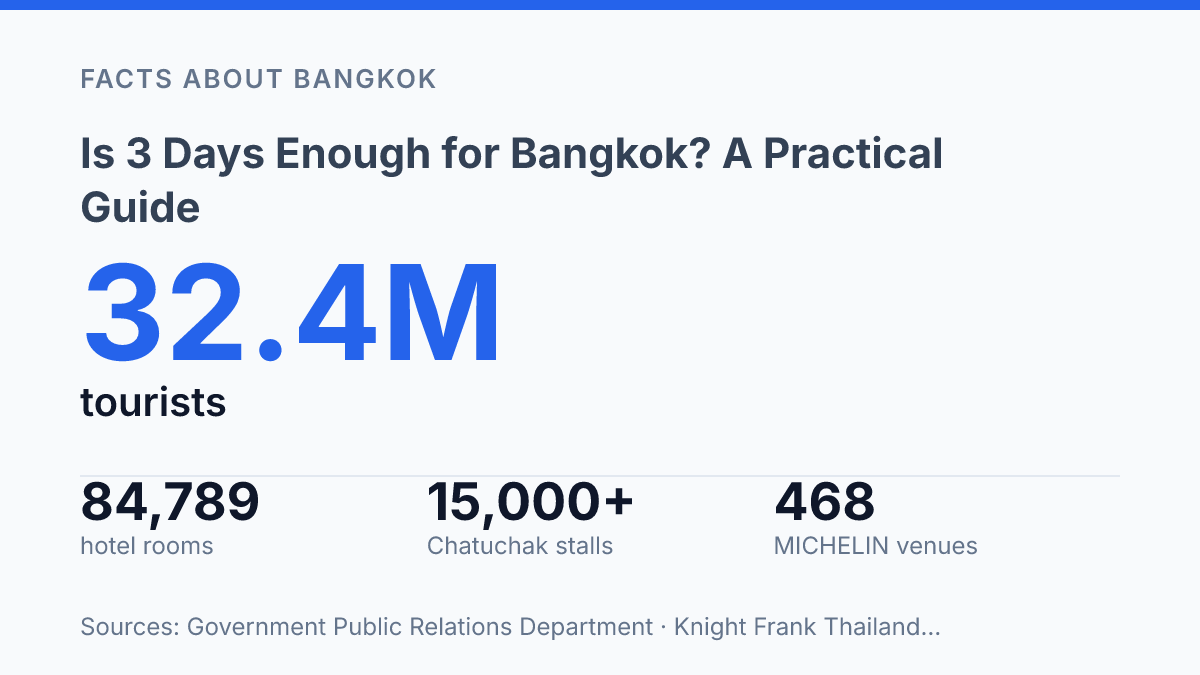
Is 3 days enough for Bangkok? The evidence points to a qualified yes: a city that received 32.4 million tourists in 2024 can support a compact first visit, but only if the itinerary is built around distance, opening hours, and crowd pressure rather than wish lists. The Grand Palace stops selling tickets at 3:30 PM, Wat Pho stays open until 7:30 PM, and MRT usage regularly exceeds 426,000 trips a day, so timing and geography shape the trip as much as personal interest.
A three-day plan can cover the Old City, river temples, modern shopping districts, night markets, and selected food experiences, but it leaves little margin for slow exploration. The useful question is not whether Bangkok has enough to fill three days; it is what kind of Bangkok those three days can realistically reveal.
What a 3-day Bangkok trip can cover
Bangkok drew 32.4 million tourists in 2024, ahead of Istanbul and London, according to Government Public Relations Department / Euromonitor, which helps explain why a short visit works best as a tightly prioritised highlights trip rather than open-ended wandering. In practical terms, the answer to “Is 3 days enough for Bangkok?” is yes for the core sights, provided the itinerary stays selective and groups nearby experiences together.
A realistic first visit can anchor one day around the royal and temple sights of the old city. The Grand Palace and Wat Phra Kaew usually form the main royal and religious stop because they combine ceremonial architecture, national symbolism, and one of Thailand’s most important Buddhist images in a single complex. This is not a quick background stop; it is the kind of visit that benefits from arriving early and allowing enough time for security, dress-code checks, crowds, and heat.
The river can fit naturally into the same overall highlights plan without turning the schedule into a checklist. Wat Arun, on the opposite side of the Chao Phraya, pairs well with a river crossing or short boat ride because the transfer itself becomes part of the experience: it shows the city from the water, links older riverside districts, and gives a clearer sense of why the river remains central to Bangkok’s layout.
One larger commercial or market experience is also feasible, but usually not several. A weekend itinerary may justify Chatuchak Weekend Market, while a non-weekend trip may work better with Siam for malls and dining or Asiatique for an evening riverside setting. Choosing one prevents the shopping component from taking over time that is better reserved for temples, food, transit, and rest.
Three days can therefore cover the classic Bangkok introduction: royal landmarks, a major temple across the river, a Chao Phraya ride, Thai food, and one substantial shopping or market district. What it does not offer is much slack for slow neighbourhood wandering, repeat visits to favourite areas, or multiple out-of-city excursions without making the schedule feel compressed.
How to structure three days by area
The most efficient three-day Bangkok plan is usually a map problem, because crossing the city at the wrong time can consume more energy than the sightseeing itself. Average MRT use reached 488.2 thousand trips per working day in 2024, according to Bangkok Expressway and Metro, which reflects how much daily movement concentrates around rail corridors. For a short stay, that makes geographic grouping more useful than ranking sights one by one.
The Old City works best as a single cluster rather than a place to dip into repeatedly. The Grand Palace, Wat Pho, and nearby temples sit close enough to be planned as one area, but this part of Bangkok is less convenient for BTS travel than Siam or Sukhumvit. Taxis and ride-hailing can help, yet traffic around major roads and ceremonial districts can slow progress, so the practical advantage comes from staying in the district once there rather than leaving and returning later.
Riverside planning should follow the Chao Phraya rather than the road grid. Wat Arun fits naturally with ferry connections, and river piers can also link daytime temple visits with a later riverfront stop or dinner cruise. This approach reduces dependence on surface traffic and gives the route a clear north-south logic, especially when combined with a hotel, pier, or transit station that makes the river easy to reach.
Siam and Sukhumvit are better treated as the modern-city portion of the trip. The two areas are connected by BTS, have dense concentrations of malls and restaurants, and are easier for evening plans than the historic core. Placing shopping, casual dining, rooftop bars, or spa time here helps absorb schedule changes, since rail access gives the itinerary more flexibility if earlier sightseeing takes longer than expected.
What may have to be left out
A single excursion to Ayutthaya can replace an entire Bangkok day, not merely fill a spare morning. The former capital sits 86 km north of Bangkok, and the Tourism Authority of Thailand describes it as a major capital for 417 years, with another TAT article noting that its historical park contains 67 temples and ruins and is too large to be fully discovered within a day. That scale makes it one of the strongest candidates for a separate day trip, but it also means that adding it to a three-day schedule usually displaces slower time at temples, a museum visit, or a long meal stop back in the city.
Floating markets create a similar time cost because the appeal is tied to timing, transport, and the market’s operating rhythm rather than a quick stop between urban sights. Damnoen Saduak is commonly treated as a morning excursion, while Amphawa is often associated with a later-day or weekend visit, so either one can shape the rest of the day around getting there and back. These markets are not lesser experiences; they are simply difficult to combine with a full Bangkok sightseeing day without making the schedule feel compressed.
Nightlife-heavy areas also tend to fall away when the priority is temples, street food, and early starts. Khao San Road may suit travelers looking for backpacker bars and late-night energy, while Thonglor is better known for polished restaurants, cocktail bars, and a more local-meets-expat evening scene. Both can be worthwhile, but they compete with the practical demands of a short visit: late nights make early temple entries harder, and a focused food itinerary may already include enough evening stops without adding a separate nightlife circuit.
The main opportunity cost is not distance alone, but recovery time and sequencing. In a three-day stay, one large excursion or late-night plan can be enough to remove the margin that makes the rest of the itinerary comfortable. The cleanest approach is to treat these add-ons as priorities only when they match the trip’s central purpose, rather than trying to attach them to an already full highlights schedule.
When a longer stay makes more sense
The clearest reason to add time is food: the MICHELIN Guide Thailand 2026 selection lists 468 dining venues nationwide, including street-food-style Bib Gourmand entries, selected restaurants, and starred dining. Bangkok accounts for a major share of Thailand’s destination eating, and a traveler planning reservations, market meals, regional Thai cooking, and late-night food streets will usually find three days restrictive. Food-led travel also works poorly when every meal has to fit around sightseeing transfers, because the best use of time may be to build parts of the day around specific neighborhoods rather than monuments.
A longer stay also makes sense when Bangkok is being used as a base rather than a standalone city break. Ayutthaya is the obvious historical add-on, while Kanchanaburi appeals to travelers interested in river scenery, wartime history, and a slower provincial rhythm. These trips are possible as excursions, but they change the character of the visit: time that might have been used for museums, massage, markets, or unhurried meals in Bangkok becomes transport and recovery time.
Slower temple visits are another reason to extend. A short stay tends to reward efficient sequencing and early starts, while a fuller visit allows more time for less prominent temple complexes, museum context, photography, and breaks during the hottest part of the day. That difference matters for travelers who are less interested in checking off headline sights and more interested in understanding how royal, religious, and neighborhood spaces sit alongside everyday city life.
Three days therefore fits best as a city-break pace: concentrated, selective, and focused on a strong first impression. A broader Thailand itinerary needs a different calculation, because Bangkok may need to serve several roles at once: arrival city, cultural base, food destination, shopping stop, and launch point for nearby provinces. When those roles are all part of the plan, four to six days in and around the capital is often a more realistic frame than trying to compress the city and its add-ons into a long weekend.
What the three-day limit really decides
Three days in Bangkok is less a measurement of adequacy than a choice about depth. The itinerary becomes strongest when it treats each day as a cluster, not a checklist, and accepts that some high-value experiences depend on timing: Chatuchak only makes sense on a weekend, Michelin-led dining may require reservations, and Ayutthaya adds an 86 km side trip before the sightseeing even begins.
A longer stay is not necessary for every first visit, but it changes the character of the trip from coverage to context. That difference matters most for travelers whose priorities are food, neighborhood wandering, temples beyond the headline sites, or day trips outside the city.
Frequently Asked Questions
Q: Is 3 days enough to see Bangkok?
A: Three days is enough for a focused first visit, especially if the goal is to see a few major temples, one or two markets, and a riverfront area. It is not enough for a complete city experience, because Bangkok is large and travel times can be significant. A short stay works best when the itinerary is grouped by district.
Q: What should be included in a 3-day Bangkok itinerary?
A: A balanced short itinerary usually combines the Grand Palace or Wat Pho area, a canal or river trip, and a modern district such as Siam or Sukhumvit. Night markets or street food areas can fill the evenings without requiring long cross-city travel. This mix gives a useful sample of the city’s historical and contemporary sides.
Q: How many temples can realistically be visited in three days?
A: Two to four major temples is a practical pace for most visitors. Temple visits often take longer than expected because of transport, walking, dress requirements, and the time needed to move between sites. Trying to see too many usually reduces the quality of each visit.
Q: Is it better to stay near the old town or near the BTS in Bangkok?
A: The better location depends on the itinerary, but BTS-linked areas are often more efficient for a short stay because they reduce time spent in traffic. The old town is more convenient for heritage sites such as the Grand Palace and Wat Pho. For many short trips, a central hotel near transit offers the best balance of access and flexibility.
Q: Should a first-time visitor to Bangkok book tours or explore independently?
A: Independent travel works well for central districts and many major sights, especially when public transit or river transport can be used. Tours can be useful for complex day plans, early starts, or destinations outside the core city where transfers are less straightforward. The best choice depends on how much time is available and how much planning a trip requires.