
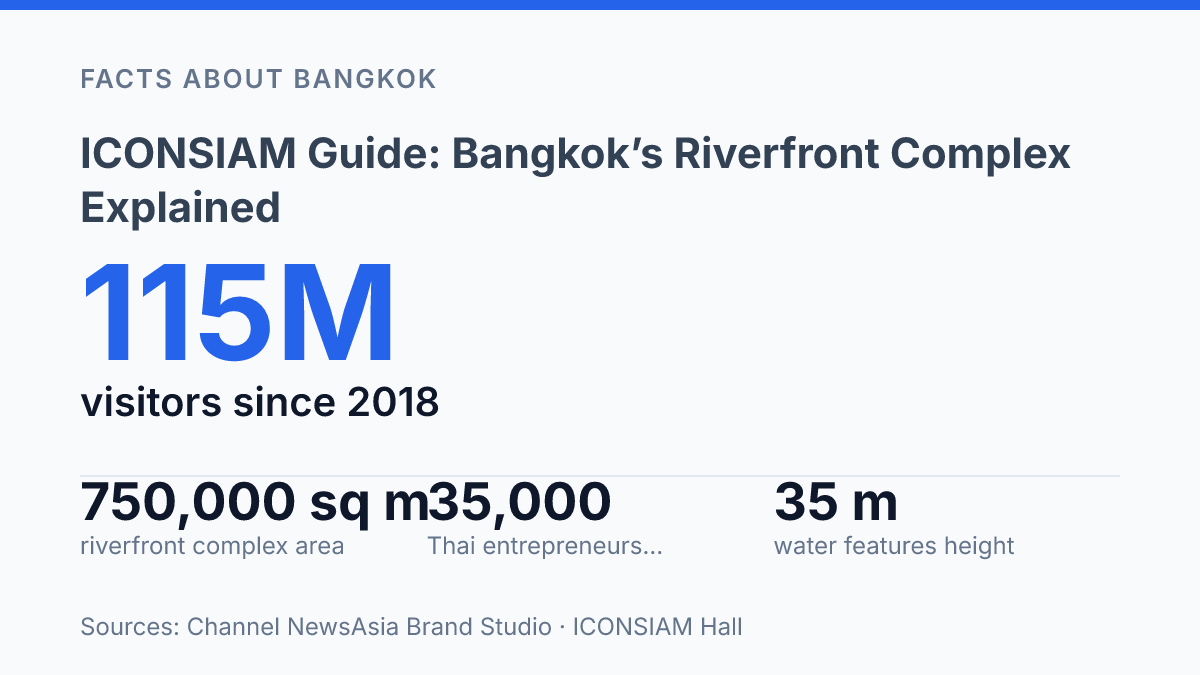
ICONSIAM opened in November 2018 as a THB60 billion riverfront project, a scale that made it more than another Bangkok shopping centre from its first day. The 750,000 sq m complex on the Chao Phraya River combined more than 300 luxury boutiques, restaurants and lifestyle brands with anchors that were new to Thailand, including Siam Takashimaya and the country’s first Apple Store.
Its location on the Thonburi side also gave Bangkok retail a different centre of gravity, linking high-end shopping, cultural presentation and river transport in one highly visible site. The guide explains how the complex is laid out, why its opening drew attention beyond retail circles, what distinguishes visitor areas such as SookSiam and River Park, and which practical details matter when planning a trip.
What ICONSIAM is and where it sits on the river
A 750,000 sq m complex on Bangkok’s riverfront functions less like a single mall than a district-scale arrival point for shoppers, hotel guests and residents. Channel NewsAsia Brand Studio reported in 2025 that the development extends across this large riverside site, a scale that helps explain why it is commonly treated as a destination rather than a conventional shopping centre. Its mix brings together a large retail mall, hotel uses and residential towers, so daily activity is not limited to short shopping visits; the site also serves overnight guests, private residents, diners and people attending events.
The formal address places the development at 299 Charoen Nakhon Rd, Khlong Ton Sai, Khlong San, Bangkok 10600, Thailand. This location is on the Thonburi side of Bangkok, directly on the banks of the Chao Phraya River, rather than in the city’s older retail clusters around Siam or Sukhumvit. That position gives the complex a prominent river frontage and makes the water part of its identity, not just a view from the upper floors.
Because the site faces the river, visitor movement is shaped by both land and water access. Arrivals can concentrate along the Charoen Nakhon frontage, at riverside entry points and through transit links serving the Khlong San area, which spreads foot traffic across more than one edge of the property. This helps the complex draw from sightseeing routes on the river as well as from local road and rail movements.
The same setting also makes access more dependent on planning than a mall built around a central roadside intersection. The riverfront is a strength for atmosphere, orientation and tourism appeal, but it means the easiest approach may vary by starting point, time of day and transport mode. In practical terms, the complex operates as both a retail address and a river destination within Bangkok’s broader urban fabric.
Why the 2018 opening mattered for Bangkok retail
Few Bangkok mall launches arrived with as many first-to-market anchors as the opening weekend in November 2018. The shopping mall opened to the public on 9 November 2018, giving Bangkok a new large-scale retail destination at a time when the city was already highly competitive in department stores, luxury shopping and lifestyle-led malls. The distinction matters because the mall is only one component of the wider mixed-use project: it functions as the public retail, dining and entertainment core, while the overall development includes other property uses with different operating patterns and audiences.
According to Channel NewsAsia Brand Studio, the THB60 billion / S$2.4 billion mixed-use project opened in November 2018 with more than 300 luxury boutiques, restaurants, fashion and lifestyle brands, plus an indoor floating market. That scale positioned the retail component as more than another shopping centre; it combined high-end tenants, mass-market attractions and Thai cultural merchandising in a single destination format.
Anchor tenants helped explain why the launch drew attention beyond ordinary mall openings. Bernama reported in 2018 that Siam Takashimaya became Thailand’s first Takashimaya store, occupying 36,000 sq m across seven floors. The complex also introduced Thailand’s first Apple Store, the first Nike Kicks Lounge in Southeast Asia and Asia’s largest Adidas Originals store, giving the launch a cluster of retail debuts that competitors could not easily match at the time.
The opening mattered because it expanded Bangkok’s mall competition from size alone to destination-making. A large opening can generate immediate crowds, but lasting retail value depends on whether the tenant mix, food offer, leisure elements and local identity remain compelling after the novelty fades. In this case, the early positioning was clear: the project sought to compete not only as a place to shop, but as a full-day commercial attraction capable of drawing residents, tourists and brand partners into the same retail environment.
What visitors find inside the complex
A visitor can move from a regional Thai market concept to a riverside event lawn and then into private residential or hotel circulation without leaving the same development. At its core is a large shopping mall, but the property is not organised as a stand-alone retail box; it also incorporates hotel accommodation and residences, giving the site several overlapping user groups rather than a single stream of shoppers.
The retail floors support the most visible visitor activity, with food, fashion, services, entertainment and cultural presentation arranged as reasons to linger rather than simply make a purchase. SookSiam, for example, brings together cuisines, crafts and products from 77 provinces of Thailand, according to the venue’s official hall information. That format turns part of the complex into a curated domestic showcase, which helps explain why some visits resemble sightseeing more than conventional mall browsing.
Outdoor and event-oriented spaces broaden the pattern of use beyond shopping hours. River Park is described by the venue as covering more than 10,000 sq m along the Chao Phraya River, while its multimedia water features reach up to 35 metres. These elements give the property a public-facing riverfront function, especially for performances, seasonal displays and evening visits, even though the space remains part of a privately managed development.
Mixed-use design tends to distribute activity across more of the day. Hotel guests, residents, retail customers, office and service staff, event crews, restaurant diners and delivery operations all move through or around the property at different times. The result is convenience for many users, because dining, shopping, accommodation and riverfront recreation sit close together, but the same layering can make the complex feel more intricate than a single-purpose shopping centre.
That complexity is part of its urban role. The site operates as a visitor attraction, but also as a working property with back-of-house logistics, residential privacy, hotel service standards and retail crowd management. For visitors, this means the most public areas may feel open and leisure-oriented, while other routes, lifts and entrances are shaped by the needs of people who live, stay or work there every day.
Practical details for planning a visit
For visit planning, the most useful detail is not a marketing tagline but the navigational address that ride-hailing apps and taxi drivers can resolve precisely: 299 Charoen Nakhon Rd, Khlong Ton Sai, Khlong San, Bangkok 10600, Thailand. This places the site in Khlong Ton Sai subdistrict within Khlong San, on Bangkok’s west-bank river corridor rather than in the city’s more familiar Siam or Sukhumvit retail areas. That district context matters because arrival times can be shaped by cross-river movement, Charoen Nakhon Road traffic and the chosen mix of rail, road or river access.
The main telephone contact is +66 2 495 7000. Calling ahead is the most reliable option for current access arrangements, event-day entry controls, accessibility questions, lost property queries or confirmation of services that may change during holidays and large public events. No general opening hours should be assumed without checking an official source, because published map listings and third-party travel pages can lag behind operational changes.
For rail-based access, Thailand.go.th lists the Gold Line as a 2.8 km route with four stations, daily service from 6:00 to 24:00, a peak frequency of 6 minutes and a flat fare of 16 baht; Charoen Nakhon Station is marked as “Icon Siam.” These details make the Gold Line a useful reference point for planning, especially for arrivals connecting from Bangkok’s wider transit network. Transport conditions still vary by day and time, so official transit updates and the complex’s own contact channels remain the safest checks before setting out.
Why the riverfront connection still shapes the visit
The next test for ICONSIAM is not only visitor volume, but whether the riverfront model continues to support movement between tourism, local enterprise and daily urban access. The numbers already point to influence beyond the site itself, from more than 115 million visitors to reported growth in nearby land values and riverside businesses.
Yet the practical value of the complex still depends on ordinary details: transit reliability, clear wayfinding, river access and whether cultural retail remains more than decorative packaging. For a visitor, the most useful implication is simple: treat the complex as part mall, part transport-linked river district, and plan enough time for both the building and the waterfront setting.
Frequently Asked Questions
Q: What is ICONSIAM in Bangkok?
A: ICONSIAM is a mixed-use development on the banks of the Chao Phraya River in Bangkok. It combines a large shopping mall with hotels and residences, making it more than a retail destination. The site opened to the public on 9 November 2018.
Q: Where is ICONSIAM located?
A: The complex is at 299 Charoen Nakhon Rd, Khlong Ton Sai, Khlong San, Bangkok 10600, Thailand. Its riverfront position places it on the Chao Phraya River, which is a major part of its identity and access pattern. The location is central to how visitors reach it by road or boat.
Q: What can visitors find inside ICONSIAM?
A: ICONSIAM includes a large shopping mall, along with hotels and residential components. That mix means it functions as a commercial, hospitality, and living development in one place. For visitors, the mall is the main public-facing draw.
Q: When did ICONSIAM open?
A: The shopping mall portion of ICONSIAM opened to the public on 9 November 2018. That date is often used as the landmark opening for the broader development in public references. It marked the start of its role as a major Bangkok retail destination.
Q: How can ICONSIAM be contacted?
A: ICONSIAM’s published phone number is +66 2 495 7000. This is the main contact listed for general enquiries. For travel planning or visit-specific questions, contacting the property directly is usually the most reliable option.