
How Many People Live in Bangkok? Current Population Insights starts with a number that looks precise but fails the street test: 5,455,020 registered residents in 2024.
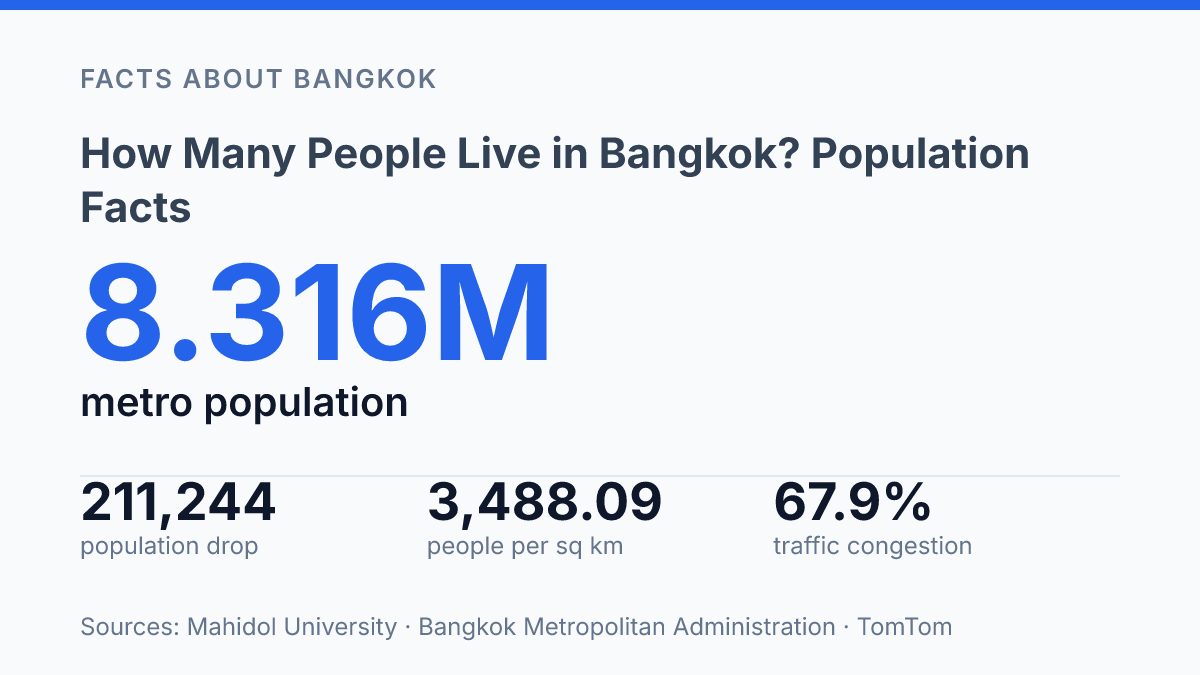
The problem is the next estimate refuses to fit. Bangkok’s official count includes 102,189 non-Thai residents, but Mahidol University put the metropolis at 8.316 million at midyear. That is nearly 2.86 million more people.
It’s not a rounding error. It’s the difference between a city on paper and the city you sit in at 6 p.m.
The official total has fallen since 2019, yet traffic, housing demand, waste loads, and health services don’t feel lighter. In my honest opinion, the real story is not whether Bangkok is growing or shrinking. It’s who gets counted, who gets missed, and why those missing people still need roads, rooms, clinics, and trains.
Bangkok’s latest population count
Bangkok’s official count for 2024 is lower than its 2019 total by 211,244 people. The headline answer is still clear: the city had 5,455,020 registered residents in the latest official tally.
That figure comes from the registration system tied to the Department of Provincial Administration, not a street-by-street count of everyone sleeping, studying, or working in the capital. For 2024, Bangkok’s official population was 5,455,020 registered residents, including 102,189 non-Thai residents; Khlong Sam Wa had 214,311 registered residents and Samphanthawong had 18,845, according to the Bangkok Metropolitan Administration, Statistical Profile of BMA.
The boundary matters. This number refers to the Bangkok Metropolitan Administration area, the 50-district capital governed by City Hall. It does not mean the wider urban region that spills into Nonthaburi, Samut Prakan, Pathum Thani, and nearby provinces.
That distinction trips people up. When someone asks how many people live in Bangkok, they may mean the legal city, the built-up urban area, or the larger metro economy. Those are not the same thing, and each gives a different answer.
The recent trend also runs against the easy assumption that Bangkok’s official population keeps climbing. In 2019, the registered count stood at 5,666,264. By 2024, it had fallen by about 3.7%, including a smaller drop from 2023 to 2024.
But the official figure is not the same as the number of people in Bangkok on a normal day. In my view, this is the number to quote when you need the official answer. It is not the number to use when judging how full the city really is.
Why the official number undercounts real life
Bangkok can look like it’s shrinking in a house book while its trains, dorms, and worksites are absorbing millions of unregistered lives. Mahidol University’s Institute for Population and Social Research put Bangkok Metropolis at 8.316 million people at midyear 2024, about 2.86 million above the registered total. That gap is the story.
Thailand’s tabien baan household registration system records where a person is officially attached, not always where that person sleeps, studies, or earns wages. A worker from Ubon Ratchathani can rent a room in Din Daeng for years and still stay registered at a family home upcountry. Moving the registration means paperwork and family decisions, so many don’t bother.
For transport and service planning, hidden-population data tells a sharper story. According to National Statistical Office data reported by Thailand Plus, Thailand had 9.25 million latent or unregistered people nationwide, including 8.40 million night-time non-registered residents and 0.85 million daytime commuters. Bangkok held 32.8% of the night-time hidden population, which works out to about 2.76 million people before the daily worker and student inflows are fully felt.
The daytime figures make the mismatch even clearer. Bangkok accounted for 52.5% of hidden daytime workers and 55.3% of hidden daytime students in that same dataset.
The city can look smaller on paper than it feels on the street. That mismatch is the whole point.
Provincial migration supplies much of this invisible weight. Workers arrive from the Northeast, the North. The South for construction, retail, delivery, domestic work, food service, and office support.
Migrants from nearby countries, especially Myanmar, Cambodia, and Laos, add another layer. Some appear in labour-permit systems. They still may not show up as Bangkok household residents.
Registration data still matters. It decides legal residence and shapes some budget formulas. But it’s a poor proxy for the daily load on trains, clinics, schools, footpaths, and rental rooms. In my honest opinion, the smarter reading is to treat the official count as Bangkok’s administrative skeleton, not its living body.
How Bangkok compares with other Asian capitals
Bangkok can look smaller than Manila on paper and larger than Singapore in daily life, all from the same basic mistake: comparing borders as if they mean the same thing.
Take Jakarta. Indonesia’s capital region, DKI Jakarta, had about 10.7 million people in 2023, according to Statistics Indonesia. Its wider Jabodetabek urban region is far larger, with estimates above 30 million.
That makes Bangkok look moderate by comparison. The match is uneven. Jakarta’s core province is not the same kind of unit as Bangkok’s city administration, and its commuter belt is massive.
Manila creates the opposite problem. The City of Manila had about 1.85 million residents in the 2020 Philippine census, according to the Philippine Statistics Authority. Metro Manila, though, reached 13.48 million. If you compare Bangkok only with Manila city, Bangkok looks huge.
If you compare it with the National Capital Region, Bangkok looks smaller. Both comparisons are technically true. One is useful. The other is misleading.
Singapore is cleaner statistically but still tricky. The Department of Statistics Singapore put the country’s total population at about 6.04 million in 2024.
That number covers an entire sovereign city-state, not a municipal core surrounded by separately governed suburbs. Against Singapore, Bangkok’s registered city figure sits in a similar range, but Bangkok’s daily footprint spills into neighboring provinces in a way Singapore’s national count already contains.
A fairer regional comparison uses the Bangkok metropolitan region rather than the city proper. That wider area is commonly understood to include Bangkok plus surrounding provinces such as Nonthaburi, Pathum Thani, Samut Prakan, Samut Sakhon, and Nakhon Pathom. On that basis, Bangkok belongs in the same conversation as Manila’s metro area, even if it doesn’t approach Jakarta’s giant urban spread.
In my humble opinion, the most honest comparison is not city versus city, but pressure versus pressure. Bangkok’s official count makes it look manageable next to Asia’s biggest capitals, but its rail lines, roads, rental markets, and service demand tell a larger story.
Boundaries shrink the number. Daily movement expands it.
What the numbers mean for housing, traffic, and services
A 10 km evening trip in Bangkok can take 31 min 25 sec, according to the TomTom Traffic Index for 2025. That turns a short cross-town errand into a planning problem.
The same index says drivers lose 115 hours a year in rush-hour traffic. You feel that loss in missed dinners, late pickups, and delivery fees that quietly rise.
Rail helps. It doesn’t erase the pressure. BTS and MRT lines move huge numbers of workers into central areas each day, then dump that demand back onto sidewalks, buses, taxis, and motorbike queues.
Expressways do the same in a different way. They speed up longer trips for some drivers. They also feed more vehicles into the same dense inner districts.
Housing shows the unevenness even more clearly. Central neighborhoods can have high rents, small units, and low registered occupancy at the same time.
BMA’s 2024 profile counted 3,304,462 registered houses across Bangkok, with an average of 1.65 registered people per house. In districts such as Huai Khwang and Watthana, the registered ratio sat below one person per house, a clear sign that paperwork doesn’t match actual use.
Outer areas tell a different story. Families priced out of central Bangkok often look toward Nonthaburi or Samut Prakan for larger homes, newer condos, or lower monthly costs. That can improve living space.
It trades rent pressure for commute pressure. Cheaper housing isn’t cheap if it adds two hard hours to every workday.
Public services carry the same uneven load. The BMA listed 11 city hospitals, 69 public health centers, and 2,808 hospital beds in its 2024 profile. Those facilities serve registered residents, unregistered residents, workers, students, and visitors who need care where they actually are, not where their documents say they belong.
A bigger population doesn’t make every district worse. That’s the easy mistake.
Some places absorb growth through rail access, new housing, and better services. Others get the costs without the relief. In my view, that uneven strain is the real population story in Bangkok, because it shapes daily life more than any single headline count.
The number Bangkok plans with is not the number Bangkok lives with
Planning Bangkok by house registration alone is a budget mistake, not a data choice.
The next useful step is boring but urgent: treat registered residents, night-time hidden residents, daytime workers, and students as separate planning groups. TomTom already shows the cost of pretending movement doesn’t matter. In 2025, rush-hour drivers lost 115 hours. That time loss is a population signal as much as a transport one.
In my humble opinion, Bangkok doesn’t need a cleaner headline number. It needs numbers that match use. Count the people who sleep there, work there, study there, and pass through it every day… or keep building a city for fewer people than the city actually serves.
Frequently Asked Questions
Q: What is Bangkok’s current population?
A: Bangkok’s registered population is about 5.6 million people. The real number is much higher once you include commuters, migrants, and unregistered residents. That gap matters because the city functions like a far larger metro area than the official count suggests. In my view, the official figure is useful. It misses the daily reality of the city.
Q: Why do different sources give different population numbers for Bangkok?
A: They use different boundaries. Some count only the city proper, while others include the wider metropolitan area, which pushes the total much higher. That’s why one source may say 5.6 million and another may point to more than 10 million.
Q: Is Bangkok bigger than other major Thai cities by population?
A: Yes, and by a wide margin. Bangkok is Thailand’s largest city, and no other Thai city comes close in population. The contrast is sharp. The real story is how much economic activity the capital pulls in from the rest of the country.
Q: How has Bangkok’s population changed over time?
A: Bangkok has grown for decades. The pace is uneven. Growth has slowed in some core areas while the metro region keeps expanding outward. That shift changes where people live, commute, and work every day.
Q: Does the population count include tourists and expats?
A: Tourists usually aren’t included in official population totals. They can change the city’s daily population a lot. Expats may be counted if they’re registered residents, though many short-term and unregistered residents fall outside the official number. That’s why Bangkok can feel far fuller than the headline figure suggests.