
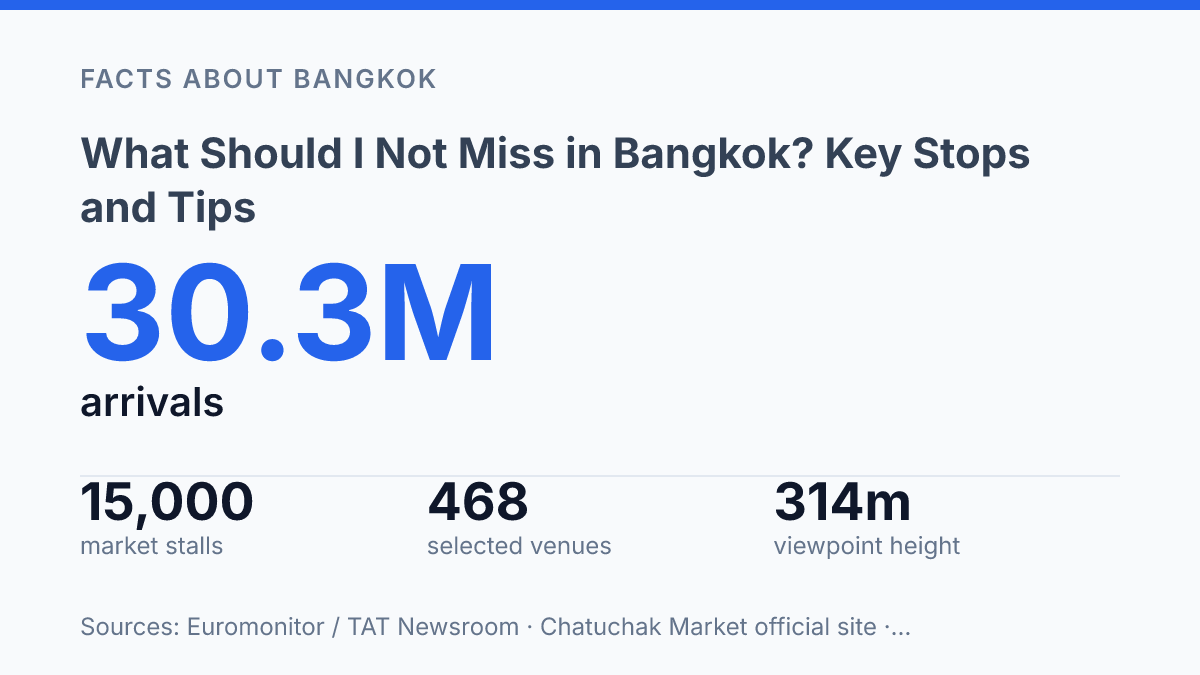
The question “What should I not miss in Bangkok?” is less about finding attractions than managing time in a city that recorded 30.3 million international arrivals in 2025. The strongest itinerary is not the longest one; it is the one that links high-value sights with realistic movement, opening hours, heat, queues, and neighborhood geography. Bangkok rewards a route that treats the Grand Palace, Wat Pho, the Chao Phraya River, Chinatown, major markets, and skyline viewpoints as connected choices rather than isolated stops.
That distinction matters because a 500-baht palace ticket, a 46-metre Reclining Buddha, a weekend market with more than 15,000 stalls, and a 314-metre observation deck cannot all be handled well without priorities. The sections ahead focus on the places that justify limited time, the planning details that prevent avoidable delays, and the combinations that work best on a short visit.
Essential temples and royal landmarks
Three of Bangkok’s heaviest-hitting historic sights sit close enough to combine, yet they can still absorb most of a day when security, dress rules, ticketing, and river transfers are included. The Grand Palace is the central anchor because it combines royal architecture with Wat Phra Kaew, the Temple of the Emerald Buddha, inside the same walled complex. As a former royal residence, the site is not just decorative heritage; it explains why this part of the old city remains the symbolic core of official Bangkok. According to the Bureau of the Royal Household, foreign admission is 500 baht, ticket sales run from 8:30 AM to 3:30 PM, and the palace remains open daily until 4:30 PM; the public entrance changed to Mani Noppharat Gate on 10 January 2024, a practical detail that matters around a site with strict visitor flows.
Markets, street food, and riverfront neighborhoods
Yaowarat is one of Bangkok’s rare districts where a market itinerary often works better after dark than in the morning. The Chinatown area concentrates gold shops, old shophouses, wholesale lanes, and late-night food stalls into a compact grid, making it one of the clearest places to see how eating, shopping, and street traffic overlap.
Michelin’s live Bangkok Bib Gourmand page lists 38 Bib Gourmand restaurants in Bangkok and its surroundings, which gives useful context for the city’s street-food reputation without reducing the experience to a checklist of famous dishes. In Yaowarat, the point is the density: seafood counters, noodle shops, dessert stalls, and market lanes sit close enough that the district rewards wandering more than fixed reservations.
Floating markets require more careful expectations because the best-known options are also shaped by visitor demand. Damnoen Saduak is the classic image of vendors selling from wooden boats, but its fame means tour groups, staged photo moments, and souvenir selling are part of the experience.
Amphawa, by contrast, is generally associated with weekend and evening visits, with a stronger domestic-travel feel and riverside eating around the canal. Popularity improves access, transport options, and opening reliability, but it can reduce the sense of ordinary daily trade; that tradeoff is clearest at the markets most often promoted to first-time visitors.
The Chao Phraya riverfront is the practical connector between old-city sightseeing, Chinatown edges, hotel piers, and evening dining areas. According to Chao Phraya Express Boat, from 24 June 2026 the Orange Line runs between Nonthaburi and Wat Rajsingkorn on weekdays at a flat 18 baht fare, making scheduled river transport a low-cost alternative to traffic-heavy road routes.
Cross-river ferries remain useful for short hops, while dinner cruises and private boats turn the same corridor into a slower scenic route. The river is therefore not just a backdrop; it is one of the simplest ways to move between market districts and waterfront neighborhoods without treating each stop as an isolated destination.
Modern Bangkok: malls, skyline views, and evening stops
Bangkok’s contemporary stops are most useful when treated as evening anchors rather than as a separate shopping day. The city’s popularity explains why selectivity matters: Bangkok ranked first globally for international arrivals in 2025, with 30.3 million arrivals, according to Euromonitor / TAT Newsroom. That volume is visible in the best-known malls and rooftop venues, where efficient transit access often comes with visitor-focused pricing and heavy peak-hour demand.
Siam Paragon and MBK show the clearest contrast in central Bangkok retail. Siam Paragon targets higher-spending shoppers with luxury labels, premium dining, a large cinema complex, and aquarium-style family attractions, while MBK is better known for phone accessories, casual fashion, souvenirs, and bargaining culture.
ICONSIAM sits at the more polished end of the scale, combining international brands with Thai design-led retail and indoor food zones aimed at both visitors and domestic leisure shoppers. A newer option is One Bangkok, which opened to the public on 25 October 2024; its retail component covers 160,000 square metres of net lettable area and is planned for more than 900 stores, making it a useful marker of how large mixed-use developments are reshaping central Bangkok beyond the traditional Siam shopping area.
For skyline views, King Power Mahanakhon is the most direct modern landmark because it turns the city’s height into the main attraction. Its lifts reach the 74th floor in under 50 seconds, the glass tray sits 310 metres above ground, and The Peak viewpoint rises to 314 metres. The SkyWalk’s 10 AM to midnight schedule, with last access at 11 PM, makes it practical after daytime sightseeing, although clear weather and sunset timing have a major effect on the value of the experience.
After dark, Asiatique offers a managed, riverfront version of Bangkok nightlife with restaurants, shops, performances, and a large observation wheel rather than the dense local feel of older trading areas. Rod Fai Market provides a different evening format, built around retro goods, casual eating, bars, and photo-friendly stalls. Both work best as atmosphere stops, not essential shopping missions, and they show how modern Bangkok often blends retail, dining, entertainment, and skyline views into one late-day outing.
How to fit the highlights into one short trip
A short Bangkok itinerary fails less from missing famous sights than from crossing the city too often. The practical strategy is to cluster the royal and riverside stops first, then choose one food, shopping, or skyline area that sits on a logical route rather than adding famous names from opposite sides of the city.
For a one-day plan, start early in the old city with the Grand Palace, continue on foot to Wat Pho, then cross the river by ferry to Wat Arun. This sequence works because the three stops sit close enough to form a single sightseeing block, with the river acting as part of the route rather than a detour. After that, the afternoon or evening can shift toward one priority: a riverside meal, a central shopping district reached by rail, or a viewpoint if weather and energy levels make it worthwhile.
A two-day stay allows the same core route to breathe. Day 1 can focus on the Grand Palace, Wat Pho, Wat Arun, and a nearby riverfront or Chinatown-adjacent evening plan. Day 2 can then be reserved for a market visit, a modern mall cluster, and one evening stop, keeping transfers mostly along rail or river corridors instead of relying on repeated cross-city taxi rides.
Transport choice matters because road distance in Bangkok does not reliably predict travel time. The BTS Skytrain is usually the clearest option for moving between central commercial areas, while the Chao Phraya ferry is often more efficient for riverside sightseeing than returning to the road after every stop. Taxis and ride-hailing cars remain useful for gaps between transit lines, but they are least efficient during commuter periods and after heavy rain, when surface traffic can slow sharply.
Sightseeing order should also respond to season and daily crowd patterns. Temple and palace visits are usually more comfortable early in the day, before heat builds and tour-group traffic peaks; in the rainy season, outdoor river crossings and exposed viewpoints are better kept flexible. The main constraint is pace: Bangkok has enough major stops for several days, so a short trip works best when each choice is based on proximity, opening rhythm, and transport logic, not reputation alone.
Why the best Bangkok plans leave space for delays
Bangkok planning works best when the itinerary leaves room for friction. Temple hours, river-boat routes, weekend market crowds, rain, and traffic can change the quality of a day more than the number of stops on a list. A practical next step is to fix the least flexible elements first, such as timed landmark visits or a weekend-only market, then let food stops, malls, and skyline views absorb delays.
This approach also keeps newer choices, such as One Bangkok, in proportion: useful when location and timing fit, but not a replacement for the city’s older river-and-temple core. The most efficient Bangkok day is often the one with one fewer stop and a better route between them.
Frequently Asked Questions
Q: What are the must-see places in Bangkok for a first visit?
A: The Grand Palace, Wat Phra Kaew, Wat Arun, and Wat Pho are the most commonly recommended first stops because they combine major historical, religious, and architectural value. A river cruise or ferry ride also helps connect these sights efficiently and gives a clear view of the city from the water.
Q: How many days are enough to see Bangkok’s main sights?
A: Two to three days is usually enough for the main temples, palace area, and a market or two. A longer stay allows time for neighbourhoods, museums, and slower travel between districts, which matters in a city where traffic can affect timing.
Q: Is Bangkok safe for tourists?
A: Bangkok is generally safe for visitors, especially in busy tourist areas, but petty theft, scams, and overcharging can occur. Standard precautions such as using registered taxis or ride-hailing apps, watching belongings, and confirming prices in advance reduce the most common risks.
Q: What is the best way to get around Bangkok?
A: The BTS Skytrain and MRT are often the fastest options for cross-city travel because they avoid road traffic. Boats on the Chao Phraya River are also practical for temple areas, while taxis and tuk-tuks can fill gaps for shorter trips or locations not served by rail.
Q: What should I wear when visiting temples in Bangkok?
A: Temples require modest clothing that covers shoulders and knees, and some sites may ask visitors to remove shoes before entering sacred areas. Light, breathable fabrics are practical in Bangkok’s heat, but clothing should still meet dress requirements for religious sites.