
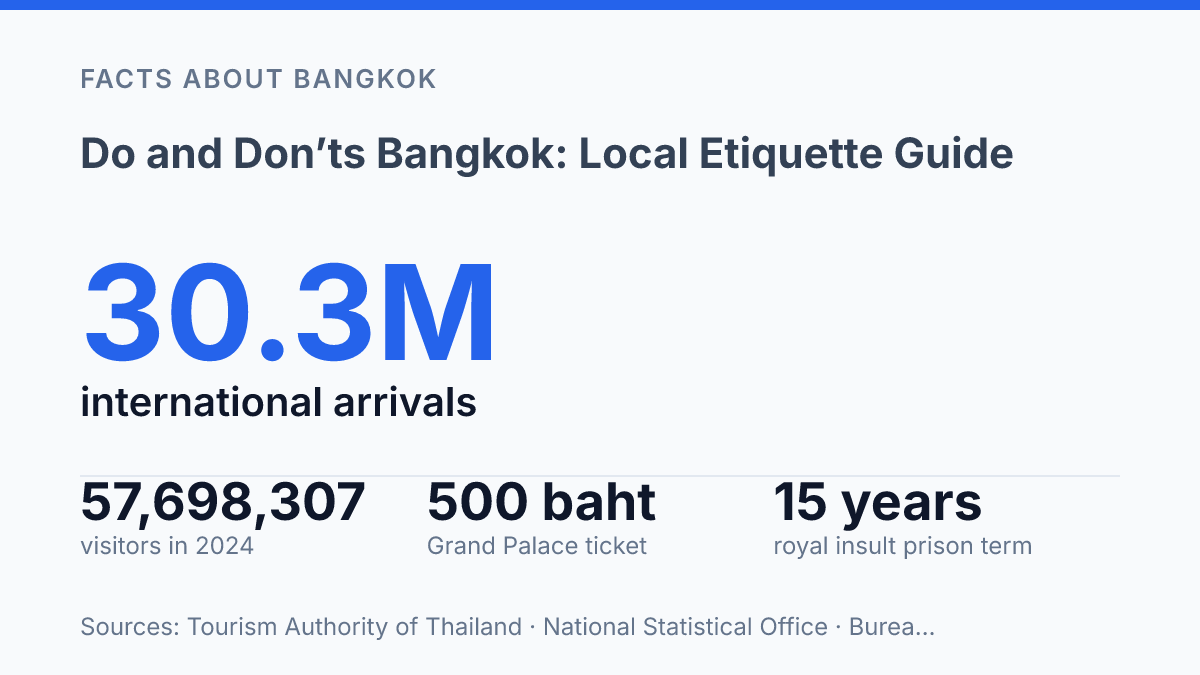
“Do and don’ts Bangkok?” is a practical search because Bangkok ranked as the world’s most visited city in 2025, with 30.3 million international arrivals. That scale changes the meaning of etiquette: small choices in dress, speech, queueing, temple conduct or public transport behaviour are not private matters in a city where tourist routes overlap with active shrines, royal spaces, commuter systems and local neighbourhoods. Bangkok also received 57,698,307 visitors in 2024, showing how often residents, worshippers and officials must manage visitor behaviour in shared places.
The rules are not limited to politeness. Some mistakes can block entry to major sites, trigger fines on the BTS, or create legal risk around vaping, alcohol, royal imagery or speech. The useful distinction is between customs that show respect and rules that carry immediate consequences.
Everyday etiquette that matters in Bangkok
In 2025, Bangkok was ranked the world’s most visited city, with 30.3 million international arrivals, according to the Tourism Authority of Thailand/TAT Newsroom. That volume of visitors makes small acts of courtesy more visible, especially in places where tourism, commuting, worship, and everyday shopping share the same space.
The wai is one of the clearest signs of politeness, but it is not used in exactly the same way in every interaction. A wai is made by pressing the palms together near the chest or face with a slight bow, and it may be offered in greetings, thanks, apologies, or respectful departures.
Visitors can return a wai when greeted by an adult in a social setting, but a polite nod or smile is often more natural when the gesture comes from hotel staff, shop employees, restaurant servers, or children. Monks are a separate case: laypeople may wai monks, but monks generally do not return the gesture in the same way.
Head and feet etiquette reflects a broader Thai sense of bodily hierarchy. The head is treated as the most respected part of the body, so touching another person’s head, even playfully, is avoided unless there is a close relationship and clear permission.
Feet carry the opposite association because they are physically lowest and touch the ground. Pointing feet at people, placing them on seats, stepping over someone, or aiming the soles toward Buddha images can be read as disrespectful rather than merely casual.
Quiet conduct is a practical rule across several everyday settings, not only at religious sites. In temples, voices should stay low, phones should be muted, and worshippers should be given space without being photographed intrusively.
On public transport, the same restraint applies through orderly queuing, moderate conversation, and attention to elderly passengers, monks, pregnant people, or others who may need priority seating. In shops and markets, calm negotiation is more acceptable than sharp complaint, and public anger tends to create embarrassment rather than resolve a disagreement.
Courtesy in Bangkok is highly context-dependent, and tourists are usually given some flexibility when mistakes are minor. The pattern that matters most is not perfect local knowledge but calm, quiet, and respectful behaviour, especially around religious symbols, older people, monks, and crowded shared spaces.
What to wear and how to behave at temples
A ticketed landmark can refuse entry for clothing that would pass unnoticed on a hot Bangkok street. At major sacred sites such as Wat Pho and Wat Phra Kaew, the safest standard is clothing that covers the shoulders and reaches at least to the knees. Sleeveless tops, low-cut or see-through shirts, very short shorts, mini skirts and gym-style tight clothing are common reasons for being stopped or asked to cover up, even when the weather makes lighter clothing feel practical.
The strictest checks are usually found at tourist-heavy royal and temple complexes rather than at small neighborhood temples. Under B.E. 2024 visitor regulations, the Bureau of the Royal Household says the Grand Palace can block entry for 11 clothing categories, including sleeveless shirts, short pants, torn pants, tight pants, bike pants and mini skirts. This matters because Wat Phra Kaew sits inside the same complex, so the site operates both as a major visitor attraction and as one of Thailand’s most significant religious and royal spaces.
Shoes should be removed before entering temple buildings, especially ordination halls, prayer halls and any interior space where Buddha images are enshrined. The usual cue is a line of footwear outside the entrance or a shoe rack near the steps. Socks are acceptable, but footwear should not be carried into the hall unless staff clearly provide a bag or instruction to do so.
Conduct inside temple grounds is shaped by the fact that many sites remain active places of worship, not only heritage attractions. Thailand’s official temple etiquette guidance advises against photographing people while they are praying, taking selfies with Buddha images, climbing historic structures, stepping on thresholds, writing on temple property, smoking, drinking alcohol or bringing drugs onto temple grounds. These rules apply even when a temple is crowded with tour groups; the presence of visitors does not suspend the religious function of the space.
Enforcement can vary, but variation should not be mistaken for permission. Smaller temples may rely more on signs and social expectation, while sites such as the Grand Palace complex often use gate checks and staff intervention. Modest dress and restrained conduct remain the safest default because they satisfy both formal entry rules and the broader expectations of an active Buddhist setting.
Public behaviour that can cause problems
A missed taxi turn or disputed bill in Bangkok is usually less damaging than the raised voice that follows it. Public arguments, sarcasm directed at staff, and confrontations with officials tend to attract the wrong kind of attention, especially in crowded stations, markets, taxi queues, and government-controlled spaces. Bangkok is accustomed to international visitors, but visible patience and self-control often matter more than confident speech or detailed explanations when something goes wrong.
Tipping is appreciated in many service settings, but it is not handled with the same expectation everywhere. In restaurants, a 10% service charge may already appear on the bill; where it does not, leaving small notes or rounding up is common rather than compulsory.
Taxi passengers often round up to the nearest convenient amount, especially for short rides, while massage shops commonly expect cash tips given directly to the therapist, with the amount shaped by length, setting, and quality of service. The practical rule is consistency rather than display: small, discreet tips fit local habits better than making the exchange performative.
Public transport has its own stricter standards because etiquette and posted regulations overlap. BTS rules list fines up to 2,000 baht for spitting, littering, or smoking in non-smoking areas, while drinking alcohol or creating a loud nuisance in the system can bring lower listed fines. These rules make crowded trains and platforms poor places for eating messily, playing audio aloud, arguing over seats, or treating station staff as informal tour guides during peak periods.
Alcohol and smoking require similar caution in pedestrian areas. According to Thailand.go.th and TAT News, effective 29 May 2026, alcohol may generally be sold from 11:00 to 24:00, while the legal drinking age remains 20 and consumption remains restricted in certain public places, including public transport areas and parks. Smoking should be kept to clearly permitted areas, and foreign travel advisories warn that vaping devices and e-liquids can be confiscated and may lead to fines or proceedings, with no tourist exemption.
Street crossing etiquette is partly about safety and partly about not disrupting already congested movement. Pedestrian bridges, crossings, and signals should be used where available, but vehicles may not stop as predictably as visitors expect, so stepping into traffic on the assumption of priority is risky.
Around markets, station exits, and major roads, pausing suddenly for photos, blocking narrow pavements, or walking in large side-by-side groups can cause irritation even when no rule is being broken. Public jokes or insults involving the royal family, including images on currency, should also be avoided because official travel advisories treat them as serious legal risks rather than ordinary bad manners.
Common mistakes first-time visitors make
The easiest mistakes in Bangkok are often made precisely where the city looks most tourist-ready: markets, taxis, temple courtyards and nightlife streets. A busy district can make local expectations feel negotiable, but relaxed commercial energy does not cancel the visible rules that still govern exchanges, religious conduct and public manners. This is why first-time visitors often misread tolerance as approval, especially when staff or bystanders avoid direct confrontation.
One recurring error is using the left hand too casually in formal or respectful situations. In everyday shopping, the mistake may pass without comment, but giving money, documents, offerings or food with the right hand, or with both hands when the exchange is more formal, reads as more careful. The same principle applies to gestures around older people, officials, religious figures or hosts, where a careless hand movement can seem dismissive even if no offence was intended.
Photography creates another common misunderstanding because Bangkok’s most visited religious places are also active spaces of worship. Monks, people praying and restricted interiors should not be treated as background material for travel photos unless permission is clear from signs, staff or the person involved. The safest assumption is that silence, kneeling, chanting or ceremonial activity signals a private religious moment, even in a crowded public site.
Tourist expectations also collide with local norms in transactions. Bargaining in markets is often possible, but aggressive haggling, public frustration or treating every quoted price as a scam can turn a routine exchange sour. In taxis, disputes over routes, fares or app bookings are better handled calmly than as a contest, because raised voices rarely improve the outcome and can draw unwanted attention.
Nightlife zones such as Khao San Road and Sukhumvit can feel more permissive because they are built around visitors, late hours and dense entertainment. That impression has limits.
Conduct that may be ignored in a bar lane can be read differently in a hotel lobby, taxi, convenience store, shrine area or temple entrance nearby. The practical mistake is assuming that a tourist district operates outside Bangkok’s usual social code, when it often only softens the edges of it.
Why small courtesies carry legal weight
Bangkok etiquette is best understood as risk management as much as cultural respect. The most reliable approach is to treat temples, stations, royal sites and public parks as regulated civic spaces, not as extensions of hotel, bar or tour environments. A light cover-up, quiet phone use, clean public transport habits and restraint around alcohol or vaping reduce most avoidable problems before they arise.
Legal and site-specific rules can also change, as alcohol-sale rules and official visitor policies show, so current notices at entrances, stations and government sources deserve priority over traveller anecdotes. In Bangkok, the practical advantage goes to visitors who assume that ordinary public behaviour is visible, regulated and socially meaningful.
Frequently Asked Questions
Q: What should visitors avoid doing in Bangkok temples?
A: Temple etiquette is strict because these are active religious sites. Visitors should dress modestly, remove shoes before entering indoor sacred areas, and avoid pointing feet toward Buddha images or monks. Speaking quietly and following posted rules helps prevent offense and keeps access open for everyone.
Q: Is it rude to touch a monk in Thailand?
A: Yes, touching a monk is generally avoided in Thai culture, especially for women. Monks also have specific rules about physical contact and gift handling, so respectful distance is the safest approach. If an interaction is necessary, a slight bow and polite manner are appropriate.
Q: Can tourists show affection in public in Bangkok?
A: Public affection is usually kept modest in Thailand, especially in religious or formal settings. Holding hands is typically acceptable, but kissing or more intimate displays can be viewed as insensitive. A conservative approach fits local expectations in most neighborhoods and attractions.
Q: How should people behave around the Thai royal family?
A: Respect for the monarchy is a serious social norm and a legal matter in Thailand. Critical remarks, jokes, or disrespectful gestures can lead to serious consequences. Visitors should avoid the topic unless they understand the local context and are speaking carefully in a neutral setting.
Q: What is the proper way to greet people in Bangkok?
A: A polite smile and the wai, a slight bow with palms together, are common signs of respect. The wai is especially suitable when greeting elders, monks, or service staff in formal contexts. Handshakes may occur in business settings, but a gentle, respectful manner is usually preferred.