Bangkok history facts get far more interesting when you realize the capital’s clock is set to 21 April 1782 at 06:54. The place was already collecting river trade duties more than 300 years earlier.
That detail changes the whole story. Bangkok didn’t appear out of empty marshland. It grew from a practical riverside post into a seat of power after Ayutthaya fell and Thon Buri held the crown for just 15 years.
The real pivot was geography. Rama I moved the court to the east bank, where the Chao Phraya bend worked like a moat and the muddy delta slowed attackers. Then came walls, canals, forts.
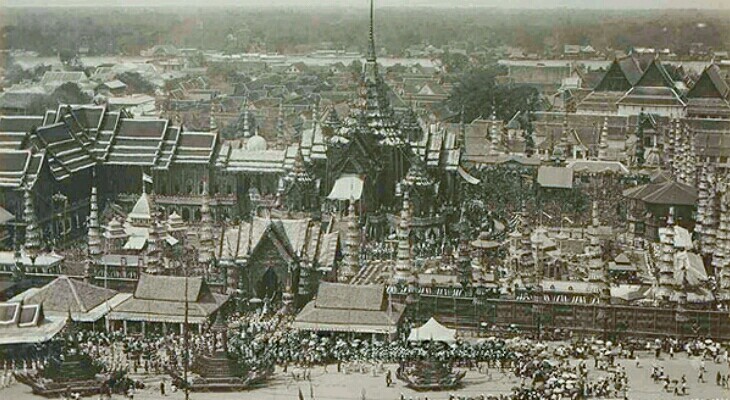
A palace complex large enough to make politics visible in stone. By the end of his reign, a wall about 7 km long enclosed the new capital. In my honest opinion, that’s the part most quick timelines flatten into a single founding date.
How Bangkok started as a riverside settlement
Bangkok’s rise began with a destroyed capital, not a master plan. Before royal courts and grand avenues entered the picture, the area worked as a practical river settlement tied to movement, taxes, and trade on the Chao Phraya. That’s the first of the useful Bangkok history facts to keep in mind: the city grew from function before it grew from ceremony.
Thonburi sat on the west bank of the Chao Phraya River, close enough to control boats moving between the Gulf of Thailand and the old inland capital of Ayutthaya. Historical records place a customs official called Nai Phra Khanon Thonburi in the reign of Chao Sam Phraya, 1424–1448, which shows the area already had a job centuries before modern Bangkok spread around it.
The river was the highway. Thonburi was one of the points where power could count, tax, and direct what passed through.
Then came 1767, when Ayutthaya fell to Burma. That collapse broke more than walls and palaces. It also shattered the old command system along the river, leaving whoever controlled movement on the Chao Phraya with a real claim to rebuilding Siamese power.
King Taksin understood that fast. He made Thonburi his base after Ayutthaya’s fall because it offered river access, trade routes.
A defensible position without pretending the old order could simply be restored. According to Britannica, Thonburi then served as Siam’s capital from 1767 to 1782, a 15-year bridge between Ayutthaya and the later capital across the river.
That’s the twist people miss. Bangkok’s origin story starts with loss, not design.
A ruined kingdom helped create the conditions for a new center of power. In my view, that reversal is the most human part of the city’s origin story.
Why King Rama I moved the capital across the river
The move across the river was not just a change of address. It was a reset of royal legitimacy.
In 1782, King Rama I founded Rattanakosin on the east bank of the Chao Phraya and made it the new royal capital. He also established the Chakri dynasty, the royal house that still rules Thailand today.
That matters. The new capital was tied from the start to a new political order, not just a new map point.
The standard explanation is practical, and it’s true. According to Britannica, the river’s broad bend helped shield the site on three sides.
The wet ground to the east made attack harder. A ruler who had just taken power needed a place he could defend, govern, and shape fast.
But defense doesn’t explain everything. The sharper point is image. A new site let the monarchy build a cleaner public face, away from recent political disorder and into a space designed around royal authority. In my honest opinion, that image-building mattered just as much as the walls, canals, and river bend.
The Grand Palace made that message physical. Begun in the same year as the capital shift, it became the royal and administrative core of Rattanakosin. The palace complex covers about 218,000 square metres, according to the Bureau of the Royal Household.
This was not symbolic in a small way. It was a capital-scale declaration.
Wat Phra Kaew sent the same signal in religious form. Placing the Temple of the Emerald Buddha beside the palace fused kingship, Buddhism, and state power at the center of the new city. If you’re tracing the city’s full story, this is the hinge: Bangkok became a capital when political authority, sacred space, and urban design were pulled onto one bank and made to speak with one voice.
Big turning points that changed the city
Two French gunboats did more to change Bangkok’s security thinking than another ring of city walls ever could. In 1893, the Paknam crisis showed that the capital’s river approach was exposed to modern naval force.
French pressure was not just a military scare. It pushed Siam to treat diplomacy, coastal defense, and administrative reform as survival tools.
After the Paknam crisis, Bangkok could no longer think like a palace city protected by geography alone. Defense had to start downriver, near the river mouth, before foreign ships reached the capital.
1932 gave Bangkok a bridge and a political shock in the same year. The opening of the Memorial Bridge, the first modern bridge over the Chao Phraya, changed movement across the city.
Ferries still mattered. A fixed crossing made daily travel between the old capital side and the west bank feel more ordinary.
Roads did not simply replace canals. They pulled government offices, shops, houses, and new districts beyond the old palace core. The 20th century stretched Bangkok outward through road corridors, canal-side communities, and administrative zones that no longer depended on the royal center for their identity.
Bangkok modernized fast. The old water-based city never disappeared. Boats kept serving markets, homes still faced canals, and low-lying land still forced planners to think with water rather than against it. In my humble opinion, that mix of canal logic and road-era sprawl is why the city feels practical and chaotic at the same time.
That is the real turning point: Bangkok did not become modern by erasing its older form. It layered new systems over old ones.
The result was not a clean grid or a single planned capital. A city that kept expanding through compromise.
How Bangkok became Thailand’s capital today
Bangkok is one of the few national capitals whose everyday English name is not the name its own administration uses. In Thai government usage, the capital is Krung Thep Maha Nakhon, a shortened administrative name tied to the much longer ceremonial title used officially in Thailand. That formal name preserves the city’s royal and religious identity even as most of the world keeps saying “Bangkok.”
Today, the city is still the country’s command center. Cabinet decisions, ministry work, royal ceremonies, national policing, courts, and state agencies all concentrate here.
The Bangkok Metropolitan Administration also runs the capital as a local government, dividing it into 50 districts. The same place has to act as both national symbol and municipal machine.
That sounds neat on paper. It doesn’t feel neat on the ground. What looks like a single capital is really two cities at once: a formal seat of power and a sprawling everyday metropolis. In my view, that split is what makes Bangkok harder to pin down than most capitals.
The modern administrative shape came late compared with the royal capital. East- and west-bank administrations were first joined as a city-province in 1971, then folded into the present capital authority in 1972, according to Britannica. That matters because the Bangkok people move through today is not just an old ceremonial core with more streets around it.
If you want the broader background beyond the capital story itself, read the city’s full story.
The short version is simple: Bangkok remains Thailand’s political heart, but its identity has never stayed inside official boundaries for long.
Conclusion
Bangkok still makes more sense when you read it from the river first, not from the skyline. The west bank, the east bank, the palace zone. The canals all keep the old logic in view, even after the modern city absorbed Thon Buri in 1972.
That doesn’t make the city simple. Taksin held the broken kingdom together before the Chakri capital took form, but his 15-year bridge often gets skipped. The result is a capital that looks sudden on paper and layered on the ground.
Next time you cross the Chao Phraya, look at the bend in the river before you look at the towers. In my humble opinion, bangkok’s past isn’t hidden. Most people are just facing the wrong direction.
Frequently Asked Questions
When did Bangkok become the capital of Thailand?
Bangkok became the capital in 1782, when King Rama I moved the seat of power across the river and began the Chakri dynasty. That shift wasn’t just ceremonial. It reset the city’s political role and set up the Bangkok you recognize today.
Why was Bangkok chosen as the capital instead of Ayutthaya?
Bangkok offered a stronger defensive position and better control over river trade. Ayutthaya had already been destroyed in 1767. The new capital needed a safer base… and Bangkok’s waterways gave rulers that edge. In my view, that practical choice matters more than any romantic story about a grand capital plan.
What is the old name of Bangkok?
The area started as a small trading settlement on the Chao Phraya River, not a purpose-built capital. The city later took on the long ceremonial name tied to its royal status, but everyday speech stayed much simpler. That gap between formal title and lived reality is part of what makes Bangkok history facts so interesting.
How did Bangkok grow so quickly after 1782?
It grew because the river made trade, transport, and defense easier all at once. The city expanded from a palace-centered core into a national capital with ports, markets, and roads.
The turn mattered fast. The population base and administrative power both concentrated there within a few generations.
Where can I learn more about Bangkok’s history and landmarks?
If you want the bigger picture, read the city’s full story in the pillar article on facts about Bangkok. It connects the early capital years to the landmarks and neighborhoods people visit now. That context helps the timeline make sense.